Flexible Frank
The Door into SummerFlexible Frank is Dan Davis’s proposed all-work household automaton: a single machine meant to take on repetitive domestic labor, from cleaning and cooking to monitoring a baby. Built first as an ungainly prototype on a powered wheelchair frame, it demonstrates its inventor’s method of teaching machines household routines; stolen amid a corporate dispute, it later reappears as an improved descendant and, finally, as the original machine Dan must dismantle to recover his drawings and notes.
Purpose and Design
Dan imagines Flexible Frank as more than another specialized appliance. Hired Girl and Window Willie could make money, but he wants one general-purpose servant that a household might buy for about the price of a good automobile, rather than a stable of separate devices. The ambition is practical and social at once: he regards housekeeping as repetitive, unnecessary drudgery and hopes automation can free women from work that the old saying insists is never finished.
The machine is not meant to imitate a human being in every respect. Dan excludes playing cards, making love, eating, and sleeping, while requiring it to clean up after a card game, cook, make beds, and tend babies. Baby care has a sharply defined safety requirement: Frank must monitor breathing and call for help if it changes. Dan also leaves telephone calls to a device already rented from A.T.&T. and door answering to equipment being installed in many new houses. The exclusions make the project’s purpose clear: not a mechanical person, but a versatile tool for domestic tasks.
Dan limits the engineering challenge to what one engineer can develop from existing technology. Most of the machine is to consist of standard parts rather than new principles. It needs hands, eyes, ears, and a sufficiently capable control system, but not a human brain. Dan describes the desired intelligence as that of a docile, repetitive worker, and distinguishes it from human judgment: the system’s apparent discretion is programmed search and response, not independent understanding.
Learning and Operation
The central component is the Thorsen memory tube. A machine can be manually guided through an operation; the tube records that operation and can direct the machine to repeat it later without a human supervisor. Flexible Frank’s control system adds hunting circuits that search for specified conditions and can interrupt a stored routine when circumstances depart from its expected pattern. The design thus combines memorized procedures with limited, task-bound responses rather than open-ended intelligence.
That scheme is intended to make Frank useful across different kinds of work. Once taught to clear a table, scrape dishes, and load a dishwasher, it can handle later encounters with dirty dishes. Dan also envisages electronically duplicated memory tubes that could let the machine perform such tasks on its first encounter, and a separate routine for changing a baby without sticking it with a pin. A square head could hold a hundred tubes, each devoted to a different household task. A guard circuit would stop the machine and make it call for help if it encountered a situation outside its instructions, protecting both dishes and babies from an improvised response.
Prototype and Demonstration
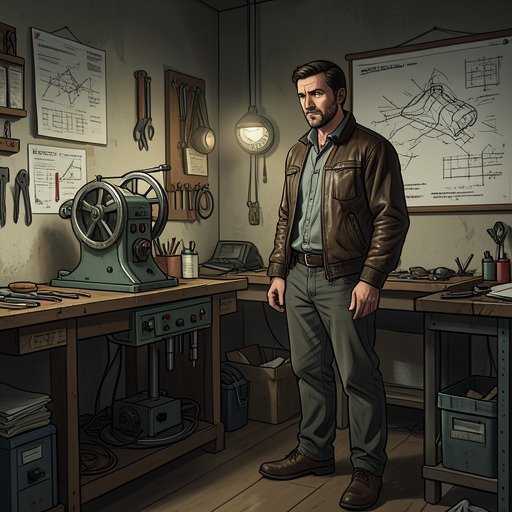
Dan builds the first Flexible Frank on the framework of a powered wheelchair. Its appearance is conspicuously makeshift: he likens it to a hat rack embracing an octopus. The comic ungainliness contrasts with its competence at a specific chore—polishing silverware—and with the broader system he is trying to establish inside the machine.
In a demonstration for Miles Gentry, Frank mixes and serves a martini, empties ashtrays while leaving clean ones untouched, opens a window and fastens it open, and dusts and tidies books in Dan’s bookcase. Miles tastes his drink and objects to the amount of vermouth. Dan replies that the machine can be instructed to make Miles’s drink differently from his own because it has blank memory tubes available. The exchange makes adaptability tangible: Frank is not merely repeating one fixed routine but can accommodate distinct household preferences by storing additional instructions.
Dispute and Disappearance
Miles proposes taking Flexible Frank from Dan and handing it to a production-engineering team for rapid manufacture and sale. Dan refuses. The dispute is not only over who will control the next stage of development: Dan later accuses Miles and Belle of stealing his notes, drawings, and working model. He argues that the machine and designs were his, and that he was not an employee of the company; much of his work had been done at night. Belle counters that he had been working for the company, while Dan points to the company’s possible exposure if the products it hoped to acquire had not belonged to it in the first place.
Thirty years later, Belle tells Dan that the original Frank disappeared. She had warned Miles not to put it in the garage, but Miles had also stuffed Dan’s notes and drawings inside the machine when it had to be moved for protection. Belle assumes Dan took it, since she believes no one else knew it mattered. Dan rejects the accusation: he had been frozen in cold sleep and had not seen Frank since the night the others outvoted him. The lost machine is therefore also a lost archive, carrying the papers needed to reconstruct the work as well as the hardware itself.
Legacy and Recovery
When Dan encounters a domestic automaton serving breakfast, he recognizes Flexible Frank’s lineage. It is not the crude first model Miles and Belle had taken from him, but a greatly improved descendant, as different in finish as a modern turbospeedster from the first horseless carriages. Dan recognizes the underlying pattern as his own work: the later machine is more efficient and polished, yet belongs to the same design line. The scene distinguishes authorship from visible refinement; industrial evolution has transformed the prototype without erasing the original design contribution.
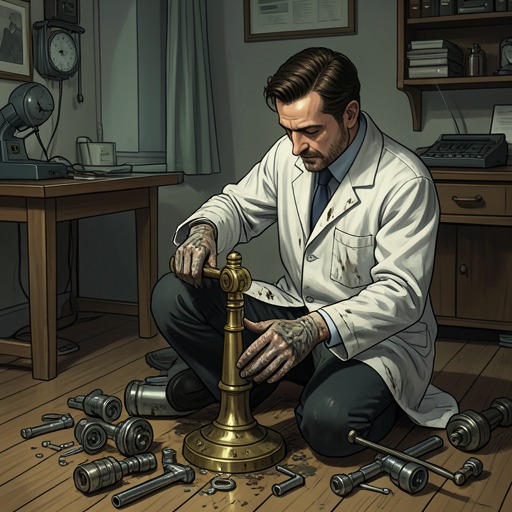
Back in 1970, Dan finds the original under a sheet in Miles’s locked garage. He uses a tire iron to force entry and first checks the wheelchair base, where he had made a temporary shelf for tools, for the missing notes and drawings. They are there: Miles had apparently put Dan’s working files into that space when moving the machine. Dan removes the papers, then dismantles Frank into pieces he can carry to his car. Knowing the construction better than anyone allows him to work faster, although the operation still occupies him for nearly an hour. In the sequence, Flexible Frank shifts from a functioning invention to a concealed repository and then to a machine broken down for recovery. Its practical design, corporate appropriation, and physical vulnerability converge in one object: the prototype that embodied Dan’s labor also preserves the evidence of it.